
Why You Are A People Pleaser
Nine times out of ten, chronic people-pleasing is not kindness… it is also not niceness.
It is attachment… and attachment is not a strength.
More specifically, it is your nervous system trying to keep you safe.
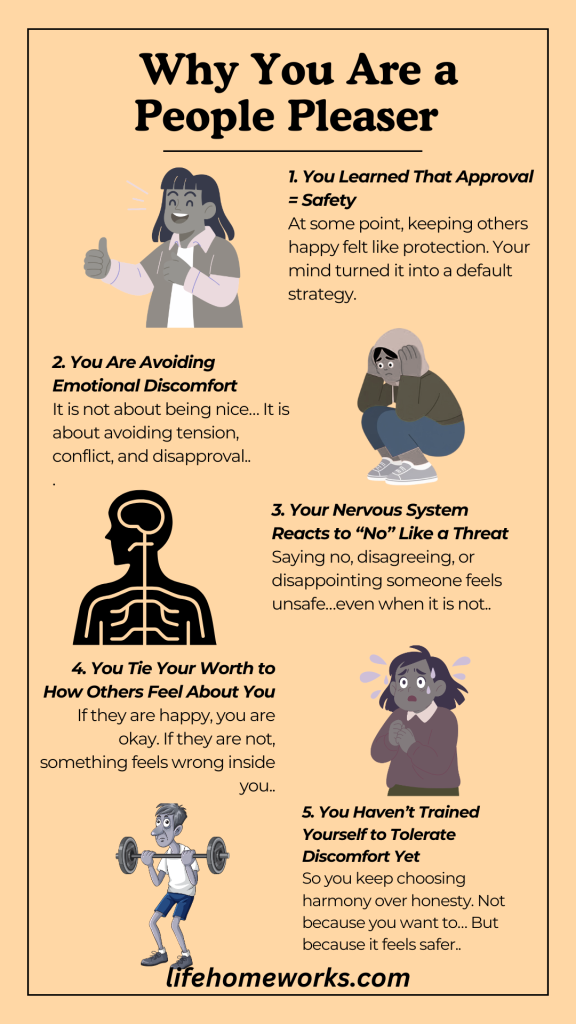
At some point in your life, your brain quietly learned an important lesson:
Keeping everyone comfortable and happy was the safest way for you to live in this world.
Maybe conflict in your home environment felt dangerous.
Maybe during your childhood, approval was how you received love.
Maybe in your life, disagreement created tension you did not know how to handle.
So your mind adapted. It built a strategy.
Agree…
Smooth things over…
Avoid friction…
Keep the peace.
In your world, in the course of your existence, these behaviors became safety.
Now, the problem is that over time this strategy starts running your life.
You say yes when you want to say no.
You absorb other people’s emotions unwillingly.
You prioritize harmony even when it costs you honesty…and you have to stay quiet.
And the moment you think about disappointing someone, something inside you tightens.
And you just have to do whatever you think pleases them.
That reaction is not weakness…It is your nervous system trying to avoid the discomfort it once learned to fear.
So people-pleasing is rarely about being “too nice.”
It is about avoiding the emotional discomfort of disapproval.

And until you address that fear, no amount of advice about “setting boundaries” will work for you.
Because the real work is not becoming less kind.
The real work is helping your nervous system learn that discomfort is survivable.
That someone being disappointed with you does not mean you are unsafe…or unworthy.
This is why the work often starts very small.
Practicing honesty in low-stakes situations.
Allowing minor disagreements to exist without rushing to fix them.
Letting someone be slightly uncomfortable without rescuing them.
Over time, these small acts retrain the system.
You stop organizing your life around approval.
And kindness slowly becomes what it was always meant to be: A choice.
Not a survival strategy.
This kind of inner retraining is exactly what practices like Life Homework are designed to support… Helping people rebuild the capacity to tolerate discomfort, detach from old patterns, and move through life with honesty instead of fear.
Because real kindness does not come from exhaustion.
It comes from inner stability.